The Auto Component Quality Problem Nobody Talks About
India is the world’s third-largest automotive market and a growing global hub for auto component exports. Yet one of the most persistent, costly quality failures in auto component plants is also one of the most preventable: contaminated metal surfaces.
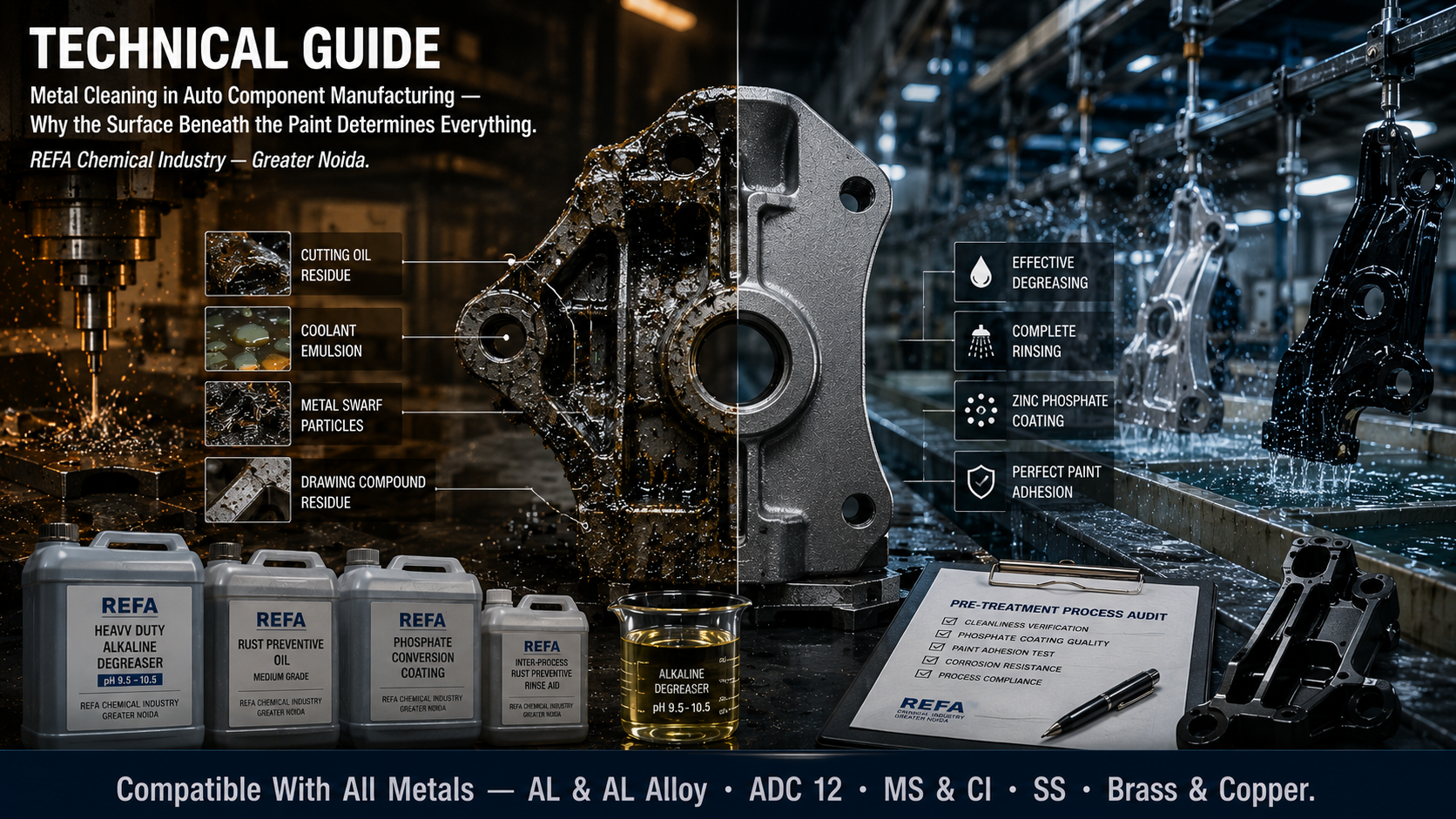
Oil, grease, metal fines, coolant residue, and drawing compounds accumulate on components during machining, stamping, and forming. When these contaminants are not properly removed before downstream processes – painting, coating, phosphating, and assembly – they cause adhesion failures, corrosion, dimensional issues, and rejection at the OEM gate.
Industry data suggests that up to 30% of coating failures in auto component manufacturing trace back to inadequate pre-treatment cleaning. The root cause is almost never the paint or coating – it is the surface beneath it.
Why Metal Cleaning is a Process-Critical Step
Many auto component manufacturers treat metal cleaning as a housekeeping function. It is not. It is a process-critical step that determines the success of every downstream operation:
- Phosphating and conversion coating: Requires a chemically clean, oxide-free surface. Any oil contamination causes patchy, non-uniform coating.
- Powder coating and painting: Even microscopic oil films cause fish-eye defects, poor adhesion, and early paint peeling.
- Assembly and tolerance fit: Grease and metal fines on bore surfaces cause incorrect fits and torque variation.
- Weld preparation: Contaminated weld zones produce weak, porous welds.
- Export packaging: Components sent for export require certified clean surfaces to meet PPAP documentation requirements.
Types of Contamination in Auto Component Plants
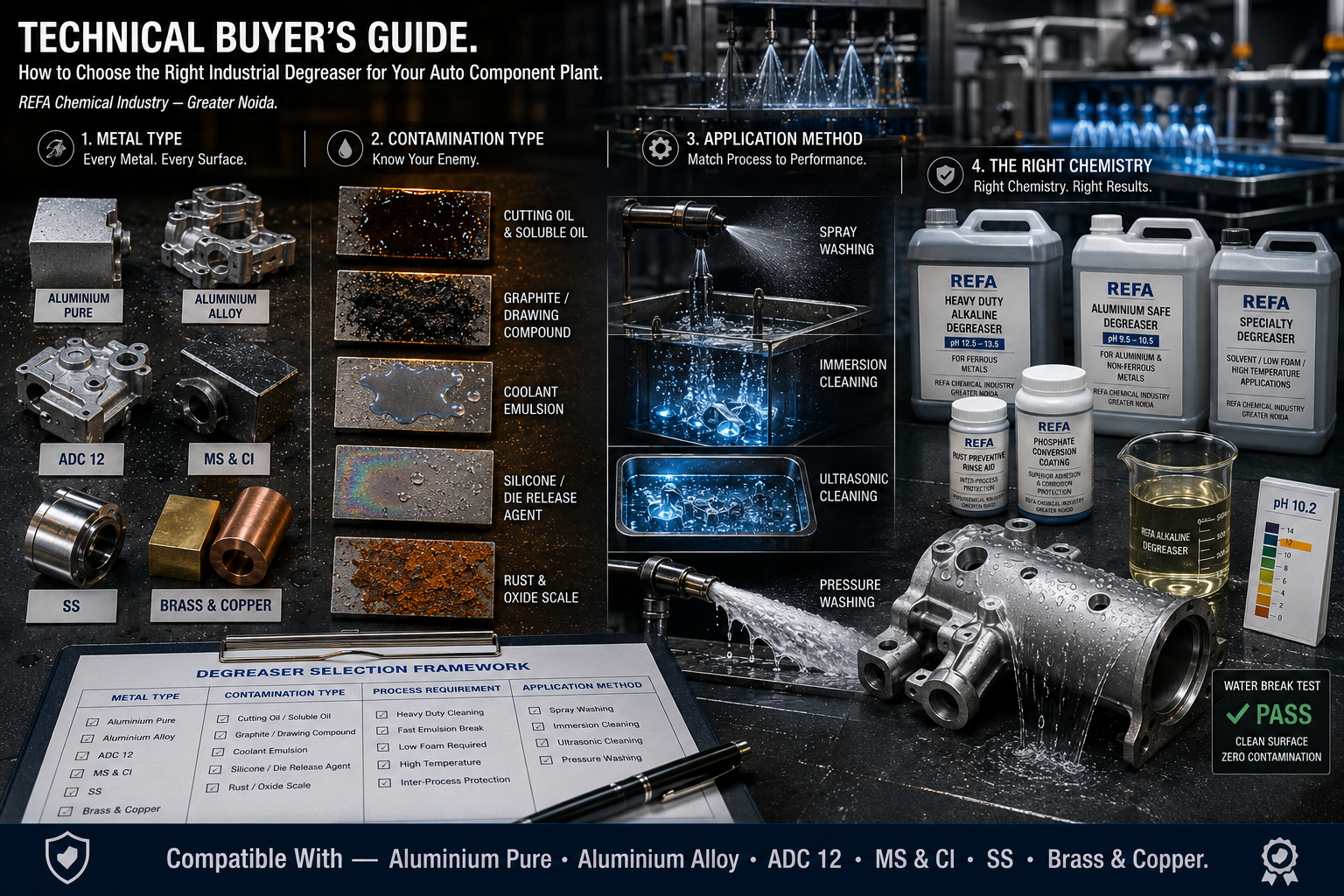
Neat cutting oils and emulsion coolants: Left over from CNC turning, milling, and grinding operations. These are heavy, film-forming contaminants that bond strongly to metal.
Stamping and drawing compounds: Used in sheet metal forming. Often graphite or wax-based — notoriously difficult to remove with standard degreasers.
Rust inhibitor films: Inter-process rust preventives must be removed completely before phosphating or painting.
Finger oils and atmospheric deposits: Lighter contamination but enough to cause adhesion failure during electrostatic painting.
Choosing the Right Metal Cleaning Chemistry
REFA Chemical Industries supplies a range of metal cleaning and degreasing products engineered for the specific demands of auto component manufacturing:
- Alkaline degreasers: Water-based, high-pH formulations ideal for spray and immersion cleaning of ferrous metals. Saponify oils and emulsify coolants effectively.
- Solvent-based degreasers: Fast-acting, for spot cleaning and areas where water-based products cannot be used.
- Ultrasonic cleaning concentrates: Low-foam, precision formulations designed for ultrasonic bath cleaning of small components and assemblies.
- Phosphate-free degreasers: For plants moving toward environmentally compliant processes without compromising cleaning performance.
REFA’s metal cleaning products are compatible with MS, CI, aluminium alloys, and copper-based components — critical in modern auto component plants where mixed-metal assemblies are common.
Process Design: 3-Stage vs 5-Stage Cleaning
The choice of cleaning process depends on the degree of contamination and the downstream requirement:
3-Stage Process (Standard Auto Component Plants)
- Stage 1: Alkaline degreasing — removes bulk oil and grease
- Stage 2: Hot water rinse — removes degreaser residue and emulsified soils
- Stage 3: Passivation / rust preventive rinse — protects cleaned surface until next operation
5-Stage Process (Export-Quality and OEM-Supplied Plants)
- Stage 1: Pre-wash degreaser — bulk soil removal
- Stage 2: Alkaline degreaser — deep cleaning
- Stage 3: Hot water cascade rinse
- Stage 4: Acid rinse / descaler — removes light scale and activates surface
- Stage 5: DM water rinse + rust preventive
REFA’s technical team can audit your existing cleaning line and recommend the right chemistry and process parameters for your specific component type and downstream requirement.
Rust Prevention Between Processes
Cleaned components are immediately vulnerable to flash rusting, especially in humid conditions. REFA’s inter-process rust preventive oils and water-based rust inhibitors form a thin, transparent film on cleaned metal surfaces, providing protection for hours to weeks depending on storage conditions.
These products are formulated to be compatible with phosphating and painting — meaning they do not need to be removed before coating. This reduces process steps and chemical consumption.
Common Mistakes Auto Component Manufacturers Make
- Using a single general-purpose degreaser for all metal types and contamination levels
- Incorrect concentration — over-diluted degreaser gives poor cleaning; over-concentrated wastes chemical and leaves residue
- Inadequate rinse stages — degreaser residue itself becomes a contaminant
- No quality check on cleaned surface — ATP swab tests or water break tests are inexpensive and catch issues before painting
- Ignoring flash rust between cleaning and coating
The REFA Advantage
REFA Chemical Industries has been supplying industrial cleaning and surface treatment chemicals to auto component manufacturers across India. Our products are used in plants supplying to Maruti Suzuki, Tata Motors, Mahindra, Hero MotoCorp, and global Tier-1 suppliers.
We offer technical support, process audits, free sample trials, and customised formulations for specific component and process requirements.
Looking for industrial metal cleaning and degreasing chemicals for auto components?
Contact REFA Chemical Industry — Greater Noida | Call / Email / WhatsApp for samples and technical consultation.